In the early 1990s, when I worked as a massage therapist in a quaint Napa Valley town in California, I read Knights Without Armor by Aaron Kipnis. The book attempts to map the private emotional terrain most men rarely name or discuss: longing, vulnerability, the hunger for connection, the need for guidance, and the generational damage passed down from fathers who were never taught how to be fathers. That seemed to be the unspoken throughline of many men I knew.
The book was homework for a personal deep dive into the so-called men’s movement, which I’d largely missed because I was more of a café-intellectual type, interested in existentialism, satire, and science fiction. My late nights were filled with cinema, going out to hear the blues or a punk band, and hanging out with friends.
Drum circles, initiation rituals, and weekend retreats to help men find their “inner warrior” seemed a bit silly to me. It all struck me as performative.
As a former hippie kid who grew up in the counterculture, I had a wealth of past experience drumming in groups, talking about feelings, and listening to self-actualization sessions. I had a life-changing initiation at the age of eleven when I donned a loincloth and sat around a fire pit in a tipi all night for a peyote ceremony in the Arizona desert.
I was a sensitive boy—and a nice guy. A bit of a Romeo when it came to girls and, later, women. Athletic in the hiking, cycling, gymnastics, tree-climbing way, but definitely not a “sports guy.” It wasn’t the sport itself I disliked, but the testosterone-charged swagger that came with it.
I read a lot—comic books, science fiction novels, and later philosophy, psychology, and anything involving semantics and communication. I was mostly secure in my skin and thought of myself as masculine, but I hated the macho bullshit that passed for masculinity.
The book struck a chord.
It made me think of myself as a masculinist. Or rather, a manthropist.
Manthropist (n.)
A philanthropist for the soul of manhood.
A manthropist can be any gender or no gender at all—the philosophy goes beyond gender entirely.
A manthropist is someone who believes masculinity doesn’t need to be “fixed” so much as properly hydrated, emotionally decluttered, and occasionally reminded to see a doctor before something goes completely awry. They are not in the business of dominating, conquering, or reenacting Bronze Age rituals with a ring light and a monetized grievance complex.
The manthropist has a simple mission:
to help men (including masculine people) become healthier, kinder, more self-aware human beings—without turning it into a battle of the sexes or a culture war.
They believe:
• Strength is not the opposite of vulnerability.
• Stoicism is useful until it becomes a personality disorder.
• Feelings don’t evaporate just because you pretend they don’t exist.
• Empathy is not estrogen in disguise.
• “Man up” is terrible advice unless you’re sitting down or you’ve fallen out of your chair.
The manthropist looks at the current state of masculinity—the influencers, the posturing, the algorithmic chest-thumping—and says, politely but firmly:
“No, thanks. I’ll be over here being a decent human instead.”
They advocate for:
• regular checkups
• therapy without shame
• authentic friendships based in honesty and sincere self-expression
• boundaries
• self-respect
• compassion toward younger men trying to navigate this gender dystopia
• compassion toward older men still carrying emotional debris from the last century
Above all, they believe that men deserve better language spoken about them and by them — because words matter, and most of what passes for “masculinity talk” online is just semantic noise on steroids.
Manthropists are pro-man without being anti-anyone
They lift up instead of punching down.
They upgrade and reboot masculinity instead of tossing it onto the trash heap or rewriting it from scratch.
They’re not perfect, but they’re doing their best—which is light years ahead of the algorithm.
If that’s a movement, great.
If it’s just a word, also great.
Either way, we all need a daily dose of manthropy.
A Field Guide for the Modern Manthropist
1. How to Talk to a Man Who Insists He’s “Fine” While Bleeding — Metaphorically or Literally
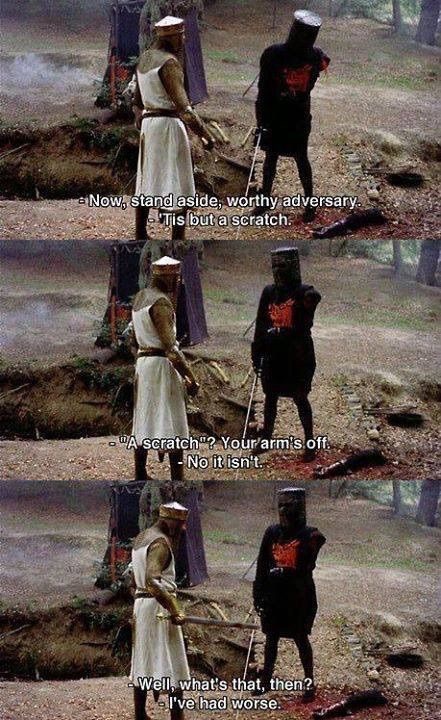
Step one: don’t panic. A man saying “I’m fine” when he’s actually an emotional wreck or gushing blood like the Black Knight in Monty Python and the Holy Grail is following a deeply ingrained cultural script that dates back to prehistoric times, when admitting weakness meant being eaten by a large cat.
Observation No. 1:
When a man says, “It’s nothing,” he is probably lying.
Not maliciously — more like my sister’s goldendoodle, Rosie, when she swallows a squeaky toy and tries to maintain her dignity.
Your job is not to call him out. Your motive is to get him to admit the truth without triggering a fight-or-flight instinct.
To begin, you might try raising an eyebrow, handing him a towel, and asking, in a completely neutral tone, “Is that your blood?”
If he replies, “I’ve had worse,” you’re making progress.
At this point, introduce a grounding statement such as:
“You are not in an action movie. You’re a civilian. Please sit down.”
Should he resist, present a simple yes/no question that cannot be dodged:
“Do you want to keep all your internal organs internal?”
Most men will concede here.
For metaphorical bleeding (heartbreak, existential dread, the realization they’ve modeled their personality after a podcast host), the protocol is similar.
Replace the towel with silence. Replace the question with:
“Do you want to talk about it, or should I just sit here like a supportive houseplant?”
Men, when offered a choice between speaking and botanical companionship, will often choose speaking. Encourage it. If he cries, let him. If you cry, blame allergies.
The goal is not to fix him. The goal is to get him to the point where he can admit, with some degree of sincerity, “Okay… maybe I’m not fine.”
Because once he says it, you’re no longer speaking to the mask—only the man behind it, relieved to be seen.
~ Richard La Rosa